When someone experiences catastrophic bleeding, the difference between life and death can come down to the actions taken in the first few minutes. Recognising severe blood loss and knowing how to respond appropriately can help save lives before emergency medical assistance arrives.
Serious injuries can happen anywhere. From workplace accidents and road traffic collisions to violent incidents and emergencies in public spaces, catastrophic bleeding is one of the most time-critical challenges faced by emergency responders.
While many people are familiar with basic first aid, fewer have received specialist training in recognising and managing life-threatening blood loss.
Understanding the dangers of catastrophic bleeding, the importance of rapid intervention and the role of appropriate trauma equipment can make a significant difference when every second matters.
What Is Catastrophic Bleeding?
Catastrophic bleeding, sometimes referred to as life-threatening haemorrhage, is severe blood loss that poses an immediate threat to a person’s life.
Unlike minor bleeding, which can often be managed with straightforward first aid, catastrophic bleeding can rapidly overwhelm the body’s ability to maintain adequate circulation.
Blood carries oxygen and essential nutrients to vital organs, including the brain and heart. When significant quantities of blood are lost, the body may be unable to maintain sufficient blood flow to these organs.
Without rapid intervention, this can lead to haemorrhagic shock, organ failure and potentially death.
Catastrophic bleeding may result from a single serious injury or multiple traumatic injuries.
Importantly, not all life-threatening bleeding is visible. Internal bleeding can occur without obvious external blood loss and requires urgent professional medical assessment.
What Causes Catastrophic Bleeding?
Severe blood loss can occur in many different situations, particularly where there is a risk of serious physical injury.
Workplace and Industrial Accidents
High-risk industries such as construction, manufacturing, agriculture, engineering and logistics can expose workers to machinery, sharp objects, heavy equipment and moving vehicles.
Incidents involving these hazards can cause deep wounds, crush injuries, traumatic amputations and significant blood loss.
For organisations operating in these environments, appropriate emergency preparedness is especially important.
Road Traffic Collisions
Vehicle collisions can result in serious injuries involving major blood vessels, internal organs and multiple areas of the body.
Severe external bleeding may be immediately apparent, while internal haemorrhage can be more difficult to recognise.
Knife Injuries and Violent Incidents
Penetrating injuries, including stab wounds, can damage blood vessels and internal structures.
Even a relatively small external wound may conceal significant underlying damage.
Falls and Crush Injuries
Falls from height, heavy-object impacts and crushing incidents can cause serious internal injuries and damage to blood vessels.
These injuries may involve significant bleeding even when there is little visible blood.
Sporting and Recreational Accidents
Certain sports and outdoor activities carry risks of serious traumatic injury.
High-impact collisions, falls and penetrating injuries can occasionally result in life-threatening blood loss.
How Can You Recognise Catastrophic Bleeding?
Recognising potentially life-threatening bleeding is one of the most important steps in an effective emergency response.
Signs may include:
- Blood flowing rapidly or continuously from a wound
- Blood spurting from an injury
- Large amounts of blood collecting around a casualty
- Clothing or dressings becoming rapidly saturated with blood
- A traumatic amputation or severe injury to a limb
- Signs of shock, including pale or clammy skin, weakness, confusion or collapse
- Deteriorating consciousness following a serious injury
Not every casualty will display all these signs.
Some individuals may initially remain conscious and able to communicate despite experiencing significant blood loss.
Any suspected catastrophic bleeding should be treated as an immediate medical emergency.
Why Does Every Second Matter?
When major blood vessels are damaged, blood loss can occur extremely rapidly.
The body relies on an adequate circulating blood volume to deliver oxygen to vital organs and maintain essential functions.
As blood loss increases, the casualty may develop haemorrhagic shock.
This can lead to reduced organ perfusion, impaired consciousness and ultimately cardiac arrest.
The speed at which deterioration occurs depends on several factors, including the location and severity of the injury, the rate of blood loss and the casualty’s underlying health.
In the most severe cases, a casualty may deteriorate within minutes.
This is why early recognition, immediate bleeding control and rapid access to emergency medical care are so important.
The first person to recognise and respond to catastrophic bleeding may be a colleague, workplace first aider, security professional or member of the public.
Appropriate action before emergency services arrive can make a vital difference.
What Should You Do If Someone Is Bleeding Severely?
If you encounter someone experiencing potentially life-threatening bleeding, your priority is to protect yourself, contact emergency services and provide appropriate first aid.
The following information offers general awareness and does not replace practical training.
1. Make Sure the Scene Is Safe
Before approaching a casualty, check for immediate dangers.
These may include moving machinery, traffic, sharp objects, electrical hazards or ongoing violence.
Do not put yourself or others at unnecessary risk.
2. Call 999 Immediately
Catastrophic bleeding is a medical emergency.
Contact emergency services as soon as possible and clearly explain the nature of the injury and the casualty’s condition.
If other people are present, ask someone to make the call while you begin providing assistance.
Follow the emergency call handler’s instructions.
3. Apply Firm, Direct Pressure
For severe external bleeding, apply firm, continuous direct pressure to the wound using an appropriate dressing or clean material.
Maintain pressure while waiting for further assistance.
Avoid repeatedly lifting the dressing to check the wound, as this may disturb clot formation.
If the wound contains an embedded object, do not remove it. Follow emergency guidance on applying pressure around the object.
4. Use Appropriate Bleeding-Control Equipment
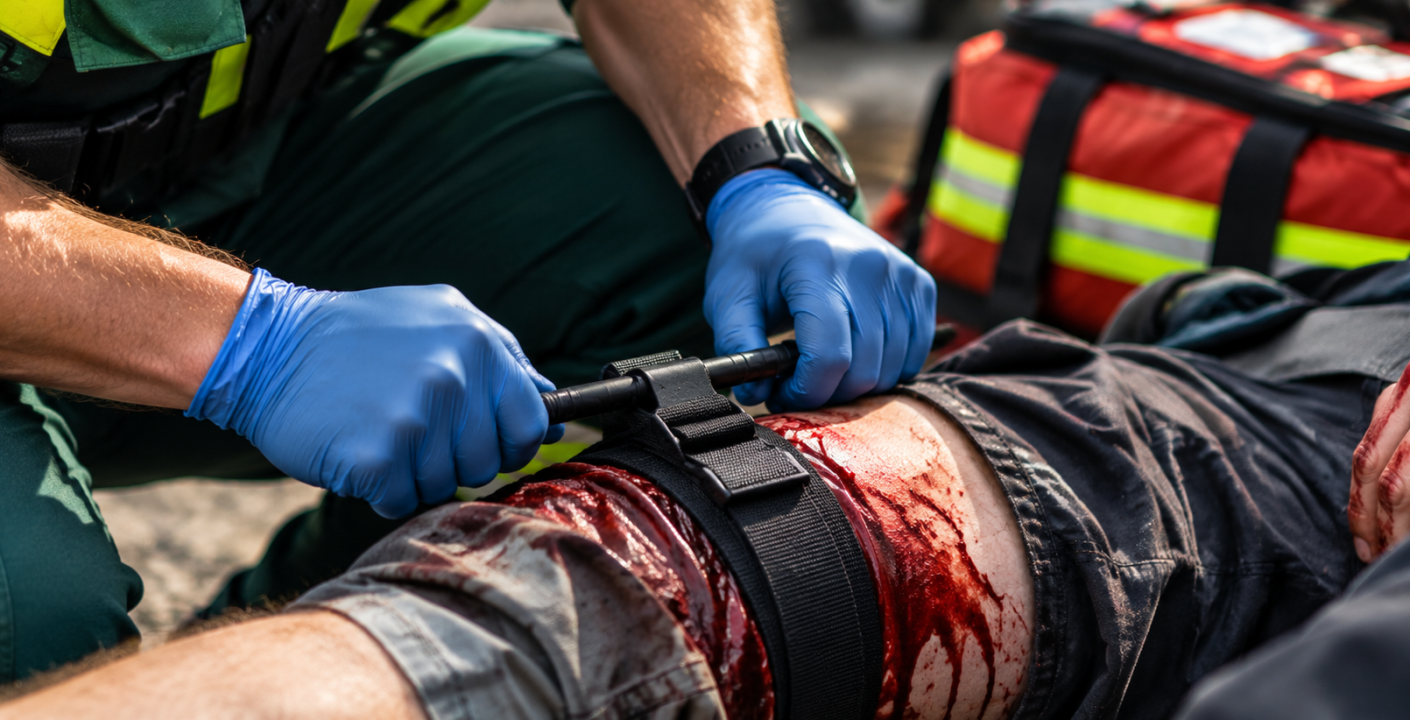
For life-threatening bleeding from an arm or leg, a manufactured tourniquet may be necessary when direct pressure cannot control the bleeding or is not feasible.
Tourniquets are specialist devices designed to restrict blood flow to a severely injured limb.
They must be used correctly and only where indicated. Practical training helps responders understand when and how to use them.
Specialist haemostatic dressings and wound-packing techniques may also form part of appropriate trauma training.
Always follow current first aid guidance, the instructions for the equipment and the emergency call handler’s advice.
5. Monitor and Reassure the Casualty
Continue monitoring the casualty’s responsiveness and breathing.
Help them remain as still as possible, protect them from becoming cold and provide reassurance while emergency services are on their way.
If the casualty becomes unresponsive and is not breathing normally, follow the emergency call handler’s instructions regarding CPR and use of an AED.
6. Provide a Clear Handover
When professional responders arrive, explain what happened, the injuries you observed and the actions you have taken.
If a tourniquet has been applied, communicate its location and the time of application, if known.
Do not loosen or remove a tourniquet once applied unless specifically directed by an appropriate healthcare professional.
What Is a Tourniquet and Why Is It Important?
A tourniquet is a device used to control life-threatening bleeding from an injured arm or leg.
When applied correctly in an appropriate situation, it can significantly reduce or stop blood flow to the affected area.
Tourniquets have an important role in modern trauma care, particularly in situations involving catastrophic limb haemorrhage.
However, they are not suitable for every injury.
For example, a limb tourniquet cannot be used to control bleeding from the chest, abdomen or other areas where it cannot be safely positioned.
Correct placement, appropriate tightening and understanding when the device is required are essential.
This is one reason why practical bleeding-control training is so valuable.
Knowing that a tourniquet exists is very different from being confident and competent in its use during an emergency.
What Is a Bleeding-Control or Trauma Kit?
A bleeding-control kit contains equipment intended to help trained responders manage serious external bleeding.
The contents vary depending on the intended environment, associated risks and the level of training provided.
A kit may include:
- Commercially manufactured tourniquets
- Trauma dressings and pressure bandages
- Haemostatic dressings
- Protective gloves
- Trauma shears
- Instructions and other supporting equipment
Some kits may also contain additional specialist items for use by appropriately trained personnel.
Organisations should select equipment based on their first aid needs assessment, the hazards present and the capabilities of their responders.
Simply purchasing trauma equipment is not enough.
The equipment must be accessible, appropriately maintained and supported by suitable training.
Why Is Catastrophic Bleeding Training Important?
Standard workplace first aid training provides essential skills for responding to a variety of injuries and medical emergencies.
However, organisations operating in higher-risk environments may need additional preparation for severe traumatic injuries.
Specialist catastrophic bleeding training can help individuals develop the knowledge and practical skills required to recognise and respond to life-threatening haemorrhage.
Depending on the programme, training may cover:
- Recognising catastrophic bleeding and haemorrhagic shock
- Understanding the priorities of trauma assessment
- Applying direct pressure and specialist trauma dressings
- Appropriate use of tourniquets
- Using haemostatic dressings and wound-packing techniques
- Communicating with emergency services
- Managing realistic trauma scenarios
- Working effectively with colleagues during an emergency
Practical, scenario-based learning is particularly valuable because it allows participants to develop familiarity with equipment and practise decision-making in a controlled environment.
Is Your Workplace Prepared for a Serious Bleeding Incident?
Many organisations have first aid kits, designated first aiders and established emergency procedures.
But would those arrangements be sufficient if someone suffered a serious traumatic injury?
The answer depends on the nature of the workplace, its specific hazards and the level of training available.
Employers should consider questions such as:
- Could employees be exposed to machinery, sharp objects, moving vehicles or other serious injury hazards?
- Have potentially life-threatening bleeding incidents been considered within the first aid needs assessment?
- Are suitable first aid supplies and specialist equipment available where the assessment identifies a need?
- Have designated responders received appropriate training?
- Can emergency services access the workplace quickly?
- Do employees understand how to raise the alarm and respond to a serious incident?
These considerations are particularly relevant for organisations operating in industrial, construction, security, transport and remote working environments.
Emergency preparedness should reflect the risks people actually face, rather than relying solely on a standard approach.
How MMTS Global Can Help
At Medical & Mental Trauma Services (MMTS Global), we understand that effective emergency response requires more than simply knowing what equipment is available.
It requires knowledge, confidence, practical competence and preparation.
Our specialist medical and trauma training solutions are designed to help individuals and organisations better understand serious injuries and develop appropriate emergency response capabilities.
Through our industry-specific medical trauma training, we can focus on the hazards and incidents most relevant to your working environment.
Training may include the use of specialist equipment such as tourniquets, trauma bandages and chest seals, alongside structured assessment and practical response scenarios.
Our aim is to help organisations develop teams that are better prepared to recognise serious injuries, respond appropriately and support casualties until professional medical assistance arrives.
Preparation Can Make a Life-Saving Difference
Catastrophic bleeding is one of the most serious and time-critical consequences of traumatic injury.
While these emergencies cannot always be predicted, individuals and organisations can take proactive steps to improve their readiness.
Recognising the signs of severe blood loss, understanding the importance of immediate action and receiving appropriate practical training can all contribute to a more effective emergency response.
When every second matters, the right preparation can make a life-saving difference.
Improve Your Organisation’s Trauma Response Capabilities
Could your team recognise and respond to a life-threatening bleeding emergency?
MMTS Global offers specialist medical and trauma training designed to support organisations working across a wide range of industries and environments.
Whether you’re reviewing your workplace emergency preparedness or looking to develop your team’s practical trauma response skills, we’re here to help.
Explore our Industry-Specific Medical Trauma Training or contact MMTS Global to discuss a programme tailored to your organisation.
Email: info@mmtsglobal.co.uk
Medical disclaimer: This article is intended for general educational and awareness purposes. It does not replace accredited practical training, professional medical advice or current emergency response protocols. In the UK, call 999 immediately for suspected life-threatening bleeding and follow the emergency call handler’s instructions.