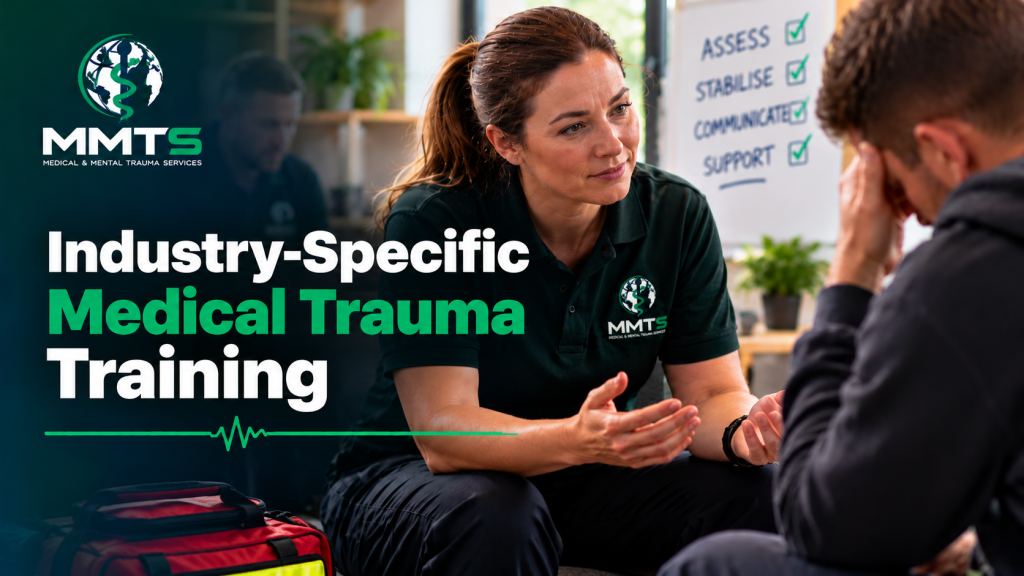
Industry-Specific Medical Trauma Training
From £160 +VAT per person
Our Industry-Specific Medical Trauma Training course provides bespoke, practical training designed around the risks and potential emergencies within your workplace. Covering serious injuries, life-threatening bleeding and the use of specialist equipment such as tourniquets, blast bandages and Russell Chest Seals, the course helps delegates develop the skills and confidence to respond to traumatic incidents. Training is tailored to your industry, working environment and operational requirements.
Explore Our Courses
Course details.
Course information
Our Industry-Specific Medical Trauma Training course provides practical, workplace-focused training to help individuals respond to serious injuries and medical emergencies that may occur within their industry.
Unlike standard first aid courses, this bespoke training is designed around the specific risks, working conditions and potential incidents associated with your business. Whether working in construction, manufacturing, engineering, security, emergency services or other high-risk environments, the course can be adapted to meet your organisation’s needs.
Delegates will learn how to assess emergency situations, recognise life-threatening injuries and provide appropriate immediate care while waiting for professional medical assistance.
Training can include the use of specialist trauma equipment such as tourniquets, blast bandages, haemostatic dressings and Russell Chest Seals, alongside techniques for managing severe bleeding, traumatic injuries and other workplace emergencies.
The course combines practical demonstrations, hands-on exercises and realistic scenarios based on the types of incidents that could occur in your working environment.
Delivered by experienced instructors, this training aims to give delegates the knowledge, practical skills and confidence to respond quickly and effectively when a serious incident occurs.
Bespoke Training
Course content, duration and practical activities can be tailored to your workplace, industry and operational requirements, ensuring the training is relevant to the risks your employees may face.
By the end of this course, delegates will be able to:
Understand the risks of serious injuries within their particular workplace or industry.
Recognise potentially life-threatening injuries and medical emergencies.
Assess emergency situations and take appropriate action.
Carry out an initial casualty assessment.
Identify and manage severe and life-threatening bleeding.
Understand the correct use of tourniquets and when they may be required.
Use specialist trauma dressings, including blast bandages and haemostatic dressings.
Understand the purpose and appropriate use of Russell Chest Seals.
Recognise serious chest injuries, penetrating wounds and crush injuries.
Identify the signs of traumatic shock and provide appropriate immediate care.
Understand the contents and appropriate use of workplace trauma kits.
Communicate effectively with colleagues and emergency services.
Provide appropriate care and monitoring while waiting for professional medical assistance.
Apply practical trauma care skills to realistic scenarios based on their working environment.
Develop greater confidence when responding to serious workplace incidents.
The specific skills covered will depend on the agreed course content and the requirements of the organisation.
This course is suitable for individuals and organisations working in environments where there is an increased risk of serious injuries or traumatic incidents.
It is particularly suitable for:
Construction and building industry workers.
Manufacturing, engineering and industrial employees.
Warehouse and logistics personnel.
Utilities, energy and infrastructure workers.
Security and close protection teams.
Police, fire and emergency service personnel.
Military and defence personnel.
Event safety and medical response teams.
Agricultural and forestry workers.
Transport and roadside assistance personnel.
Offshore and remote location workers.
Workplace first aiders and emergency response teams.
Health and safety representatives.
Organisations requiring specialist trauma training based on their operational risks.
The training can be adapted for individuals with limited first aid experience or those who already hold recognised first aid or emergency care qualifications.
Bespoke – Based on Training Requirements
Course Duration: Agreed according to the subjects covered, delegates’ experience and practical training requirements.
Delivery: Instructor-led classroom training, practical exercises and workplace-based scenarios.
Location: Training can be delivered at a suitable client location or agreed training venue.
Certification: MMTS course completion certificate, subject to the agreed training and assessment arrangements.
Course duration and content will be discussed with the organisation before training is arranged.
Delegates will have access to appropriate training equipment and learning resources for the agreed course content, which may include:
Instructor-led medical trauma training.
Practical demonstrations and hands-on exercises.
Tourniquets and specialist bleeding control training equipment.
Blast bandages and emergency trauma dressings.
Haemostatic dressing training materials.
Russell Chest Seal training equipment.
Workplace trauma kits and relevant medical supplies.
Practical casualty assessment activities.
Realistic emergency scenarios based on workplace risks.
Guidance on recognising and managing serious traumatic injuries.
Practical skills reviews and instructor feedback.
MMTS course completion certificate, where included in the agreed training package.
All specialist equipment will be provided for training purposes as appropriate to the course content.
Entry Requirements
Previous first aid training is helpful but may not be essential, depending on the agreed course content.
Delegates should have a suitable understanding of spoken and written English.
Participants must be able to take part in the required practical activities, with reasonable adjustments where appropriate.
Any specific experience or qualification requirements will be confirmed before training.
Before Attending
Please arrive on time and attend all required training sessions.
Wear comfortable clothing suitable for practical activities, including working at floor level.
Delegates should be prepared to participate in hands-on exercises and realistic emergency scenarios.
Please inform us in advance of any medical conditions, mobility requirements or additional learning needs that may affect participation.
Organisations should provide details of their working environment, relevant hazards and any specific training requirements before the course.
Bespoke Course Planning
Before training takes place, MMTS will discuss the organisation’s requirements to identify the most appropriate course content.
This may include reviewing workplace hazards, existing first aid arrangements, available trauma equipment and the types of incidents employees may be required to respond to.
Practical Training
Delegates will have opportunities to practise relevant trauma care techniques using appropriate training equipment.
All techniques will be taught in accordance with the agreed training objectives, current guidance and the delegate’s intended scope of practice.
Certification
A certificate of completion may be provided by MMTS following attendance and satisfactory participation in the agreed training activities.
This is a bespoke training course and does not automatically lead to a regulated qualification unless a separately recognised qualification has been agreed.
Course content
Lesson 1.1 – Understanding medical trauma and serious workplace injuries
Lesson 1.2 – Identifying industry-specific hazards and risks
Lesson 1.3 – The role and responsibilities of a workplace trauma responder
Lesson 1.4 – Scene safety, personal protection and emergency procedures
Lesson 2.1 – Assessing an emergency situation
Lesson 2.2 – Carrying out a primary casualty assessment
Lesson 2.3 – Recognising life-threatening injuries
Lesson 2.4 – Prioritising immediate care and contacting emergency services
Lesson 3.1 – Recognising severe and life-threatening bleeding
Lesson 3.2 – Applying direct pressure and wound dressings
Lesson 3.3 – Understanding and using tourniquets
Lesson 3.4 – Using haemostatic dressings and wound packing techniques
Lesson 3.5 – Monitoring casualties following bleeding control interventions
Lesson 4.1 – Understanding workplace trauma kits and their contents
Lesson 4.2 – Using emergency trauma and blast bandages
Lesson 4.3 – Understanding Russell Chest Seals and their application
Lesson 4.4 – Selecting appropriate equipment for different injuries
Lesson 4.5 – Safe equipment handling and ongoing casualty monitoring
Lesson 5.1 – Recognising and managing penetrating injuries
Lesson 5.2 – Responding to crush injuries and serious limb injuries
Lesson 5.3 – Recognising chest injuries and breathing difficulties
Lesson 5.4 – Recognising and managing traumatic shock
Lesson 5.5 – Providing appropriate care while awaiting emergency assistance
Lesson 6.1 – Understanding common incidents within your industry
Lesson 6.2 – Responding to emergencies in challenging working environments
Lesson 6.3 – Managing incidents involving machinery, tools or equipment
Lesson 6.4 – Working with colleagues during a serious emergency
Lesson 6.5 – Applying trauma care skills to realistic workplace scenarios
Lesson 7.1 – Communicating effectively during an emergency
Lesson 7.2 – Providing accurate information to emergency services
Lesson 7.3 – Monitoring and reassuring casualties
Lesson 7.4 – Preparing for the arrival of professional medical assistance
Lesson 8.1 – Demonstrating specialist trauma equipment
Lesson 8.2 – Practising severe bleeding control techniques
Lesson 8.3 – Completing realistic industry-specific emergency scenarios
Lesson 8.4 – Reviewing practical skills and key learning outcomes
Book your course today.
Whether you’re ready and know what you want or whether you have a custom requirement MMTS can probably help. Tell us about your organisation, where you operate and the challenges your people face.
Our team can help meet your requirements