
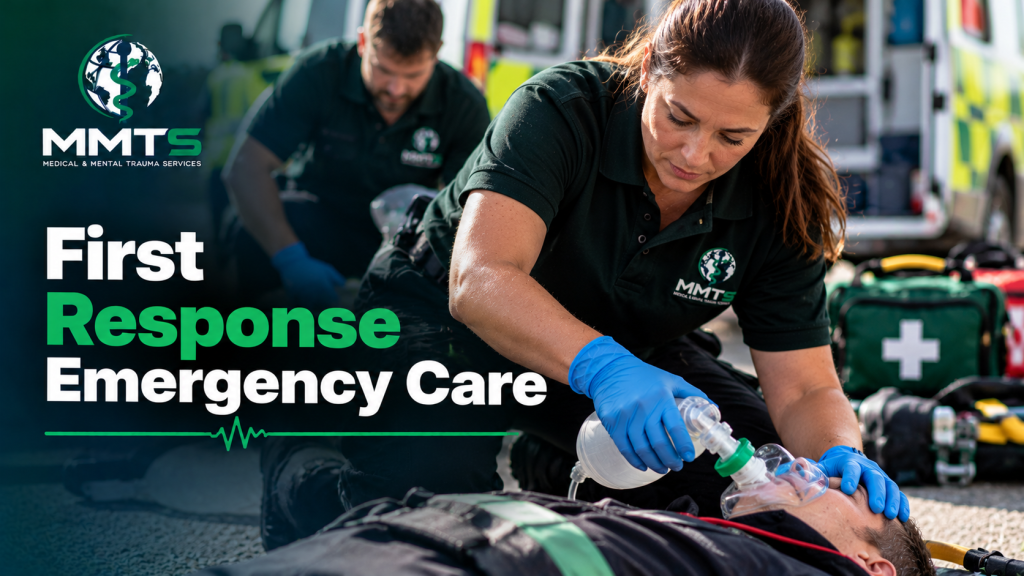
First Response Emergency Care (FREC3)
Level 3 (RQF)
£625 inc. VAT per person - 6 people minimum
£465 inc. VAT per person - 12+ people
Our First Response Emergency Care (FREC) Level 3 (RQF) course provides essential pre-hospital emergency care training for individuals who may be first on the scene of a serious incident. This five-day course covers patient assessment, airway management, CPR, emergency oxygen, life-threatening bleeding, trauma and medical emergencies. Suitable for first responders, security personnel, event medical teams and those working in high-risk environments, the course leads to a nationally recognised Qualsafe qualification.
Explore Our Courses
Course details.
Course information
Our First Response Emergency Care (FREC) Level 3 (RQF) course provides delegates with the knowledge, practical skills and confidence needed to respond to serious medical emergencies and traumatic injuries before further medical assistance arrives.
This five-day course is designed for individuals who may be first on the scene of an emergency, including those working in event medical services, security, emergency response and other high-risk environments.
Delegates will learn how to assess and manage patients, provide life-saving interventions, perform CPR, manage airways, control severe bleeding and respond to a range of medical and trauma emergencies.
The course combines classroom learning with practical exercises, realistic emergency scenarios and assessments, helping delegates develop the skills needed to provide effective pre-hospital emergency care.
Training also covers patient monitoring, emergency oxygen, the use of appropriate medical equipment and the safe management of casualties within the first responder’s scope of practice.
Successful completion leads to the nationally recognised Qualsafe Level 3 Award in First Response Emergency Care (RQF), which is valid for three years.
This qualification provides a strong foundation for individuals working in emergency response roles and those wishing to progress towards more advanced pre-hospital care qualifications.
By the end of this course, you will be able to:
Understand the role and responsibilities of a first responder.
Assess emergency incidents and identify potential risks.
Carry out primary and secondary patient assessments.
Recognise and monitor changes in a patient’s condition.
Assess and maintain a patient’s airway using appropriate techniques and equipment.
Perform adult and paediatric CPR.
Use an automated external defibrillator (AED) safely.
Recognise and manage breathing difficulties.
Administer emergency oxygen within your scope of practice.
Recognise and control severe and life-threatening bleeding.
Use tourniquets and haemostatic dressings appropriately.
Recognise and manage shock and circulation problems.
Assess and provide emergency care for trauma patients.
Recognise and manage chest, head, spinal and musculoskeletal injuries.
Provide appropriate care for burns, scalds and eye injuries.
Recognise serious medical emergencies, including heart attacks, strokes, seizures and anaphylaxis.
Respond to environmental emergencies such as hypothermia and heat-related illness.
Communicate effectively with patients, colleagues and emergency services.
Record patient information and provide a clear handover to medical professionals.
Apply your emergency care skills confidently in realistic situations.
This course is suitable for individuals who may be required to provide emergency care before an ambulance or other medical professionals arrive.
It is particularly suitable for:
First responders and emergency response volunteers.
Event medical and first aid personnel.
Security staff and close protection operatives.
Police, fire and other emergency service personnel.
Individuals working in construction and manufacturing.
Offshore, renewable energy and utilities workers.
Military personnel and those working in high-risk environments.
Outdoor activity and adventure instructors.
Search and rescue volunteers.
Community emergency response teams.
Individuals wishing to develop a career in pre-hospital emergency care.
Anyone looking to progress beyond standard workplace first aid qualifications.
Previous first aid experience is helpful but is not normally required for entry to the Level 3 qualification.
5 day course
Based on the 2025 Qualsafe Level 3 qualification specification:
Classroom Training: Five days of instructor-led learning and assessment.
Guided Learning Hours: Minimum 37 hours.
Additional Study: Approximately 18 hours of directed preparation and independent learning.
Total Qualification Time: 55 hours.
Certificate Validity: 3 years.
Qualification: Qualsafe Level 3 Award in First Response Emergency Care (RQF).
The training schedule may include pre-course study. Any extended skills or additional training must be arranged in line with the relevant qualification requirements.
Delegates will have access to the equipment and learning resources needed to complete the course, including:
Instructor-led emergency care training.
Practical exercises and realistic emergency scenarios.
CPR manikins and AED training devices.
Airway management training equipment.
Emergency oxygen training equipment.
Patient assessment and monitoring equipment.
Tourniquets, haemostatic dressings and other bleeding control training supplies.
Bandages, splints and equipment for managing injuries.
Learning materials covering emergency care procedures.
Practical assessments and theory examinations.
Qualsafe Level 3 Award in First Response Emergency Care (RQF) certificate upon successful completion.
Entry Requirements
No previous first aid qualification is normally required, although previous training or experience is recommended.
Delegates must meet the minimum age requirements set by Qualsafe and MMTS.
A suitable level of spoken and written English is required to understand the training and complete assessments.
Delegates must be able to demonstrate the practical skills required for the qualification, including CPR, with reasonable adjustments where appropriate.
Delegates should be prepared to complete any required pre-course study.
Before Attending
Please arrive on time and attend all required training sessions.
Wear comfortable clothing suitable for practical activities, including working at floor level.
Delegates must participate in practical exercises and realistic emergency scenarios.
Please inform us in advance of any medical conditions, mobility requirements or additional learning needs that may affect your participation.
Complete any pre-course reading or learning activities provided before attending.
Course Assessments
Delegates will complete practical skills assessments and theory examinations throughout the course.
All required assessments must be passed to achieve the qualification.
Certification
Upon successful completion, delegates will receive the nationally recognised Qualsafe Level 3 Award in First Response Emergency Care (RQF), valid for three years.
The qualification provides a foundation for further training and progression into more advanced pre-hospital emergency care roles.
Course content
Lesson 1.1 – The role and responsibilities of a first responder
Lesson 1.2 – Scene safety, risk assessment and incident management
Lesson 1.3 – Communication, safeguarding and patient care
Lesson 1.4 – Infection prevention and personal protective equipment
Lesson 2.1 – Carrying out primary and secondary patient surveys
Lesson 2.2 – Assessing levels of consciousness
Lesson 2.3 – Measuring and recording vital signs
Lesson 2.4 – Recognising and managing a deteriorating patient
Lesson 3.1 – Assessing and maintaining a patient’s airway
Lesson 3.2 – Basic airway management techniques and equipment
Lesson 3.3 – Performing adult and paediatric CPR
Lesson 3.4 – Using an automated external defibrillator (AED)
Lesson 3.5 – Managing airway obstruction and choking
Lesson 4.1 – Assessing breathing and recognising respiratory distress
Lesson 4.2 – Recognising common breathing emergencies
Lesson 4.3 – Understanding and administering emergency oxygen
Lesson 4.4 – Monitoring oxygen saturation and patient response
Lesson 5.1 – Recognising and controlling life-threatening bleeding
Lesson 5.2 – Using tourniquets and haemostatic dressings
Lesson 5.3 – Assessing circulation and recognising shock
Lesson 5.4 – Managing wounds and soft tissue injuries
Lesson 6.1 – Assessing and managing trauma patients
Lesson 6.2 – Recognising and managing chest injuries
Lesson 6.3 – Assessing head and spinal injuries
Lesson 6.4 – Managing fractures and musculoskeletal injuries
Lesson 6.5 – Treating burns, scalds and eye injuries
Lesson 7.1 – Recognising heart attacks and other cardiac emergencies
Lesson 7.2 – Recognising strokes and neurological emergencies
Lesson 7.3 – Managing seizures and convulsions
Lesson 7.4 – Responding to diabetic emergencies
Lesson 7.5 – Recognising and managing anaphylaxis
Lesson 7.6 – Responding to poisoning and sudden illness
Lesson 8.1 – Recognising and managing hypothermia
Lesson 8.2 – Responding to heat-related illness
Lesson 8.3 – Supporting and monitoring patients awaiting further care
Lesson 8.4 – Recording patient information and handing over to emergency services
Lesson 9.1 – Applying emergency care skills in realistic scenarios
Lesson 9.2 – Practical patient assessment and management
Lesson 9.3 – Completing required practical skills assessments
Lesson 9.4 – Theory assessments and final knowledge checks
Book your course today.
Whether you’re ready and know what you want or whether you have a custom requirement MMTS can probably help. Tell us about your organisation, where you operate and the challenges your people face.
Our team can help meet your requirements