
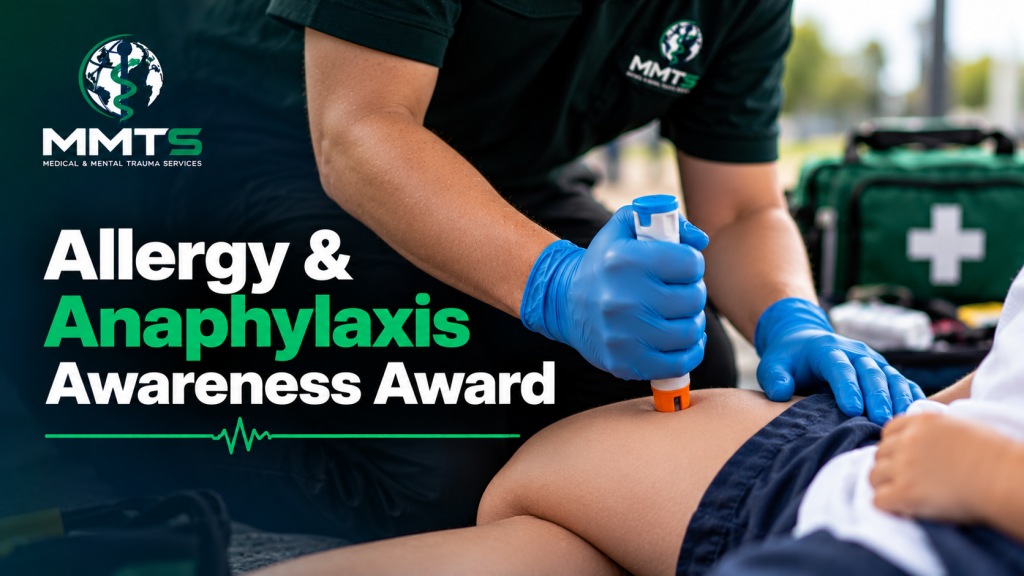
Award in Allergy and Anaphylaxis Awareness
Level 3 (RQF)
£720 inc. VAT - 12 people maximum
Our Allergy and Anaphylaxis Awareness Level 3 (RQF) course provides essential knowledge to help individuals recognise allergic reactions and understand how to respond to anaphylaxis emergencies. The course covers common allergens, symptoms, emergency procedures and the role of adrenaline auto-injectors. Suitable for education, childcare, hospitality, healthcare and other workplaces, the training leads to a nationally recognised Qualsafe qualification.
Explore Our Courses
Course details.
Course information
Our Allergy and Anaphylaxis Awareness Level 3 (RQF) course provides delegates with the knowledge and understanding needed to recognise allergic reactions, identify the signs of anaphylaxis and respond appropriately in an emergency.
This course is suitable for anyone who may come into contact with people who have allergies, including those working in education, childcare, hospitality, healthcare, leisure and other public-facing environments.
Delegates will learn about common allergens, the difference between mild and severe allergic reactions, and the importance of recognising symptoms early. The course also covers the actions to take when someone is experiencing anaphylaxis, including calling the emergency services and understanding the role of adrenaline auto-injectors.
Through clear instruction and practical examples, delegates will develop a better understanding of allergy management and the importance of acting quickly when a serious reaction occurs.
Successful completion leads to the nationally recognised Qualsafe Level 3 Award in Allergy and Anaphylaxis Awareness (RQF), helping individuals and organisations improve their awareness and preparedness for allergy-related emergencies.
By the end of this course, you will be able to:
Understand what allergies are and how allergic reactions occur.
Identify common allergens and potential triggers.
Recognise the signs of mild, moderate and severe allergic reactions.
Understand what anaphylaxis is and why it can be life-threatening.
Identify the symptoms of anaphylaxis and recognise when emergency assistance is needed.
Understand the immediate actions to take during an anaphylactic emergency.
Know when to call emergency services and what information to provide.
Understand the purpose and use of adrenaline auto-injectors.
Recognise the importance of correct casualty positioning and ongoing monitoring.
Understand how to reduce the risk of exposure to known allergens.
Recognise the importance of allergy management plans and clear communication.
Feel more confident recognising and responding to allergy-related emergencies.
This course is suitable for anyone who wants to improve their understanding of allergies and anaphylaxis, particularly those who may be responsible for supporting individuals with known allergies.
It is particularly suitable for:
Teachers, teaching assistants and school support staff.
Nursery and childcare workers.
Healthcare and care support staff.
Hospitality, catering and food service employees.
Leisure centre and sports facility staff.
Community and youth group workers.
Workplace first aiders.
Reception and customer-facing employees.
Supervisors, managers and team leaders.
Parents, carers and individuals supporting someone with allergies.
Anyone wishing to gain a recognised allergy and anaphylaxis awareness qualification.
No previous allergy awareness training is required.
Half day course
Classroom: One full day of face-to-face training.
Classroom training
Certificate Validity: 3 years.
Delegates will have access to the learning resources needed to complete the course, which may include:
Instructor-led allergy and anaphylaxis awareness training.
Learning materials covering common allergens and allergic reactions.
Guidance on recognising the signs and symptoms of anaphylaxis.
Information about adrenaline auto-injectors and their use.
Example allergy management plans and emergency procedures.
Case studies and examples of allergy-related emergencies.
Knowledge checks and required course assessments.
Qualsafe Level 3 Award in Allergy and Anaphylaxis Awareness (RQF) certificate upon successful completion.
Entry Requirements
No previous allergy awareness or first aid qualification is required.
Delegates must meet the minimum age requirements set by Qualsafe for this qualification.
A suitable understanding of spoken and written English is required to follow the training and complete assessments.
Delegates should be willing to participate in discussions, learning activities and assessments.
Before Attending
Please arrive on time and attend the full training session.
Bring any joining instructions or identification requested before the course.
Delegates must complete all required learning activities and assessments.
Please inform us in advance of any additional learning needs or accessibility requirements so suitable arrangements can be considered.
No previous experience of managing allergies or anaphylaxis is necessary.
Course Assessments
Delegates must successfully complete the assessments required by Qualsafe to achieve the qualification.
Certification
Upon successful completion, delegates will receive the nationally recognised Qualsafe Level 3 Award in Allergy and Anaphylaxis Awareness (RQF).
This is an awareness qualification and should not be treated as a replacement for practical first aid training where that is required.
Course content
Lesson 1.1 – Understanding allergies and allergic reactions
Lesson 1.2 – Common allergens and triggers
Lesson 1.3 – How allergic reactions affect the body
Lesson 1.4 – Understanding the risks associated with allergies
Lesson 2.1 – Recognising mild and moderate allergic reactions
Lesson 2.2 – Identifying symptoms of severe allergic reactions
Lesson 2.3 – Understanding how symptoms can develop and change
Lesson 2.4 – Knowing when to seek emergency medical assistance
Lesson 3.1 – What is anaphylaxis?
Lesson 3.2 – Common causes and triggers of anaphylaxis
Lesson 3.3 – Recognising the signs and symptoms of anaphylaxis
Lesson 3.4 – Understanding why immediate action is important
Lesson 4.1 – Assessing the situation and recognising an emergency
Lesson 4.2 – Calling emergency services and providing information
Lesson 4.3 – Understanding the correct positioning and care of a casualty
Lesson 4.4 – Monitoring the casualty until professional help arrives
Lesson 5.1 – Understanding the purpose of adrenaline
Lesson 5.2 – Recognising different types of adrenaline auto-injectors
Lesson 5.3 – Understanding when and how auto-injectors are used
Lesson 5.4 – Safe handling, storage and disposal considerations
Lesson 6.1 – Identifying and reducing exposure to allergens
Lesson 6.2 – Understanding allergy management plans
Lesson 6.3 – Communicating allergy information in the workplace
Lesson 6.4 – Supporting individuals with known aller
Lesson 7.1 – Reviewing key allergy and anaphylaxis awareness topics
Lesson 7.2 – Applying knowledge to example emergency situations
Lesson 7.3 – Completing the required qualification assessment
Book your course today.
Whether you’re ready and know what you want or whether you have a custom requirement MMTS can probably help. Tell us about your organisation, where you operate and the challenges your people face.
Our team can help meet your requirements