
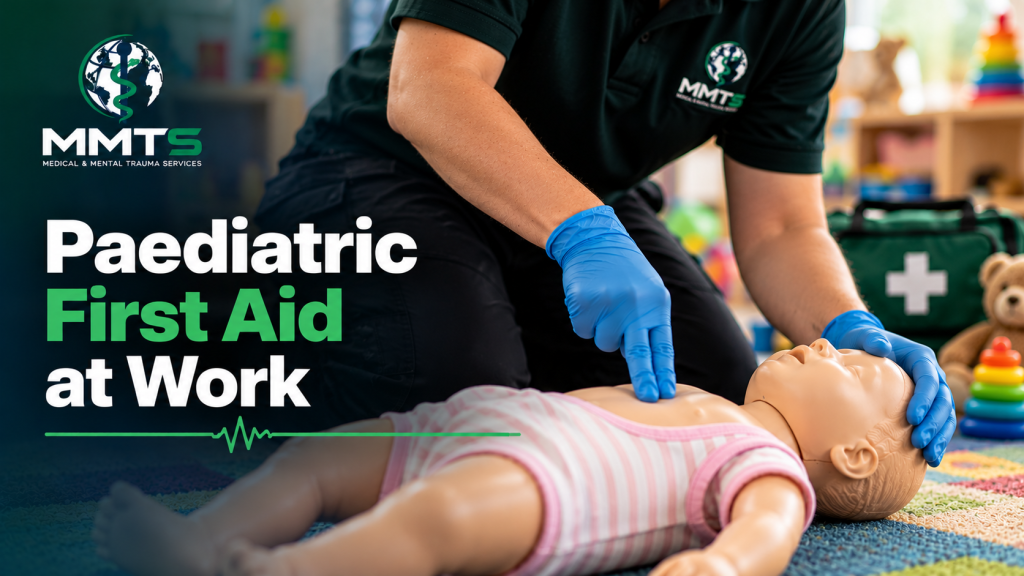
Paediatric First Aid
Level 3 (RQF)
£410 inc. VAT per person - 6 people minimum
£330 inc. VAT per person - 12+ people
Our Paediatric First Aid Level 3 (RQF) course provides comprehensive first aid training for anyone responsible for caring for babies and children. This two-day course covers infant and child CPR, choking, bleeding, injuries, allergic reactions and common childhood medical emergencies. Ideal for nursery staff, childminders, teachers and childcare professionals, the course leads to a nationally recognised Qualsafe qualification valid for three years.
Explore Our Courses
Course details.
Course information
Our Paediatric First Aid Level 3 (RQF) course provides delegates with the knowledge, practical skills and confidence needed to respond to first aid emergencies involving babies and children.
This two-day course is designed for individuals who work with or care for children, particularly those in nurseries, preschools, schools, childcare settings and other environments where paediatric first aid training is required.
Delegates will learn how to assess emergencies, perform infant and child CPR, use an automated external defibrillator (AED), manage choking and provide first aid for a wide range of injuries and medical conditions. The course also covers bleeding, shock, fractures, burns, seizures, allergic reactions and other common childhood emergencies.
Training combines classroom learning with practical exercises and realistic scenarios, helping delegates develop the confidence to respond quickly and safely when a baby or child needs assistance.
The course is designed to support the paediatric first aid training requirements of the Early Years Foundation Stage (EYFS) statutory framework in England.
Successful completion leads to the nationally recognised Qualsafe Level 3 Award in Paediatric First Aid (RQF), valid for three years.
By the end of this course, you will be able to:
Understand the role and responsibilities of a paediatric first aider.
Assess emergency situations involving babies and children.
Carry out a primary survey and recognise when emergency assistance is needed.
Recognise and manage an unresponsive baby or child.
Perform infant and child cardiopulmonary resuscitation (CPR).
Use an automated external defibrillator (AED) appropriately.
Recognise and respond to choking emergencies.
Identify and manage breathing difficulties, including asthma attacks.
Control minor, severe and life-threatening bleeding.
Recognise the signs of shock and provide appropriate first aid.
Provide first aid for fractures, sprains and other injuries.
Recognise and manage head, neck and spinal injuries.
Treat burns, scalds and injuries affecting the eyes, ears and nose.
Recognise and respond to seizures.
Identify allergic reactions and anaphylaxis.
Recognise the signs of meningitis, sepsis and other serious childhood illnesses.
Respond to diabetic emergencies and fainting.
Provide first aid for poisoning, bites and stings.
Recognise and manage heat- and cold-related emergencies.
Communicate effectively with emergency services and provide reassurance to babies, children and their carers.
Apply paediatric first aid skills confidently in a range of emergency situations.
This course is suitable for anyone who works with, supervises or cares for babies and children and requires a comprehensive paediatric first aid qualification.
It is particularly suitable for:
Nursery and preschool staff.
Early years practitioners.
Registered childminders.
Childcare workers and nursery assistants.
Teachers, teaching assistants and school support staff.
After-school club and holiday club employees.
Playgroup and activity leaders.
Sports coaches and instructors working with children.
Youth group and community volunteers.
Nannies and professional childcare providers.
Parents, grandparents and carers.
Anyone wishing to gain a recognised paediatric first aid qualification.
The course is particularly relevant to those working in early years settings who need to meet the paediatric first aid requirements of the Early Years Foundation Stage (EYFS) statutory framework.
2 day course
Classroom Training: Two days of instructor-led learning, practical exercises and assessments.
Blended Learning: May be available through a combination of online theory and practical classroom training, subject to MMTS and Qualsafe delivery arrangements.
Certificate Validity: 3 years.
Qualification: Qualsafe Level 3 Award in Paediatric First Aid (RQF).
Delegates will have access to the equipment and learning resources needed to complete the course, including:
Instructor-led paediatric first aid training.
Practical exercises using first aid training equipment.
Infant and child CPR training manikins.
AED training devices.
Bandages, dressings and other first aid training supplies.
Practical demonstrations and realistic emergency scenarios involving babies and children.
Learning materials covering childhood injuries, illnesses and first aid procedures.
Practical assessments and knowledge checks.
Qualsafe Level 3 Award in Paediatric First Aid (RQF) certificate upon successful completion.
Entry Requirements
No previous first aid training or qualifications are required.
Delegates must meet the minimum age requirements set by Qualsafe.
A suitable level of spoken and written English is required to understand the training and complete assessments.
Delegates must be able to demonstrate the practical skills required for the qualification, including infant and child CPR, with reasonable adjustments where appropriate.
Before Attending
Please arrive on time and attend all required training sessions.
Wear comfortable clothing suitable for practical first aid activities, including working at floor level.
Delegates must participate in practical exercises and complete the required assessments.
Please inform us in advance of any medical conditions, mobility requirements or additional learning needs that may affect your participation.
No previous experience of paediatric first aid is necessary.
Blended Learning
Where blended learning is offered, delegates must complete the required online theory before attending their practical classroom session. Instructions and access details will be provided before the course.
Course Assessments
Delegates will complete practical skills assessments and knowledge-based assessments during the course.
All required assessments must be passed to achieve the qualification.
Certification
Upon successful completion, delegates will receive the nationally recognised Qualsafe Level 3 Award in Paediatric First Aid (RQF), valid for three years.
Refresher training is recommended to help delegates maintain their knowledge and practical skills between qualifications.
Course content
Lesson 1.1 – The role and responsibilities of a paediatric first aider
Lesson 1.2 – Assessing emergency situations and managing risks
Lesson 1.3 – Infection prevention and safe first aid practices
Lesson 1.4 – Communicating with emergency services and reassuring casualties
Lesson 2.1 – Carrying out a primary survey
Lesson 2.2 – Assessing an unresponsive baby or child
Lesson 2.3 – Managing an unresponsive casualty who is breathing normally
Lesson 2.4 – Monitoring a casualty while waiting for emergency assistance
Lesson 3.1 – Recognising cardiac arrest in babies and children
Lesson 3.2 – Performing infant CPR
Lesson 3.3 – Performing child CPR
Lesson 3.4 – Using an automated external defibrillator (AED) with children
Lesson 4.1 – Recognising choking in babies and children
Lesson 4.2 – Providing first aid to a choking infant
Lesson 4.3 – Providing first aid to a choking child
Lesson 4.4 – Recognising and responding to asthma attacks
Lesson 5.1 – Treating minor wounds and bleeding
Lesson 5.2 – Controlling severe and life-threatening bleeding
Lesson 5.3 – Recognising and managing shock
Lesson 5.4 – Providing appropriate care while waiting for emergency assistance
Lesson 6.1 – Managing fractures and bone injuries
Lesson 6.2 – Treating muscle and joint injuries
Lesson 6.3 – Recognising and managing head, neck and spinal injuries
Lesson 6.4 – Providing first aid for burns and scalds
Lesson 6.5 – Managing eye, ear and nose injuries
Lesson 7.1 – Recognising and managing seizures
Lesson 7.2 – Identifying allergic reactions and anaphylaxis
Lesson 7.3 – Recognising meningitis and sepsis
Lesson 7.4 – Responding to diabetic emergencies
Lesson 7.5 – Recognising and managing fainting
Lesson 8.1 – Recognising and responding to poisoning
Lesson 8.2 – Managing insect bites and stings
Lesson 8.3 – Recognising heat exhaustion and heatstroke
Lesson 8.4 – Managing hypothermia and cold-related illness
Lesson 9.1 – Applying paediatric first aid skills in realistic scenarios
Lesson 9.2 – Demonstrating infant and child CPR
Lesson 9.3 – Demonstrating casualty management and injury treatment
Lesson 9.4 – Completing practical and knowledge-based assessments
Book your course today.
Whether you’re ready and know what you want or whether you have a custom requirement MMTS can probably help. Tell us about your organisation, where you operate and the challenges your people face.
Our team can help meet your requirements